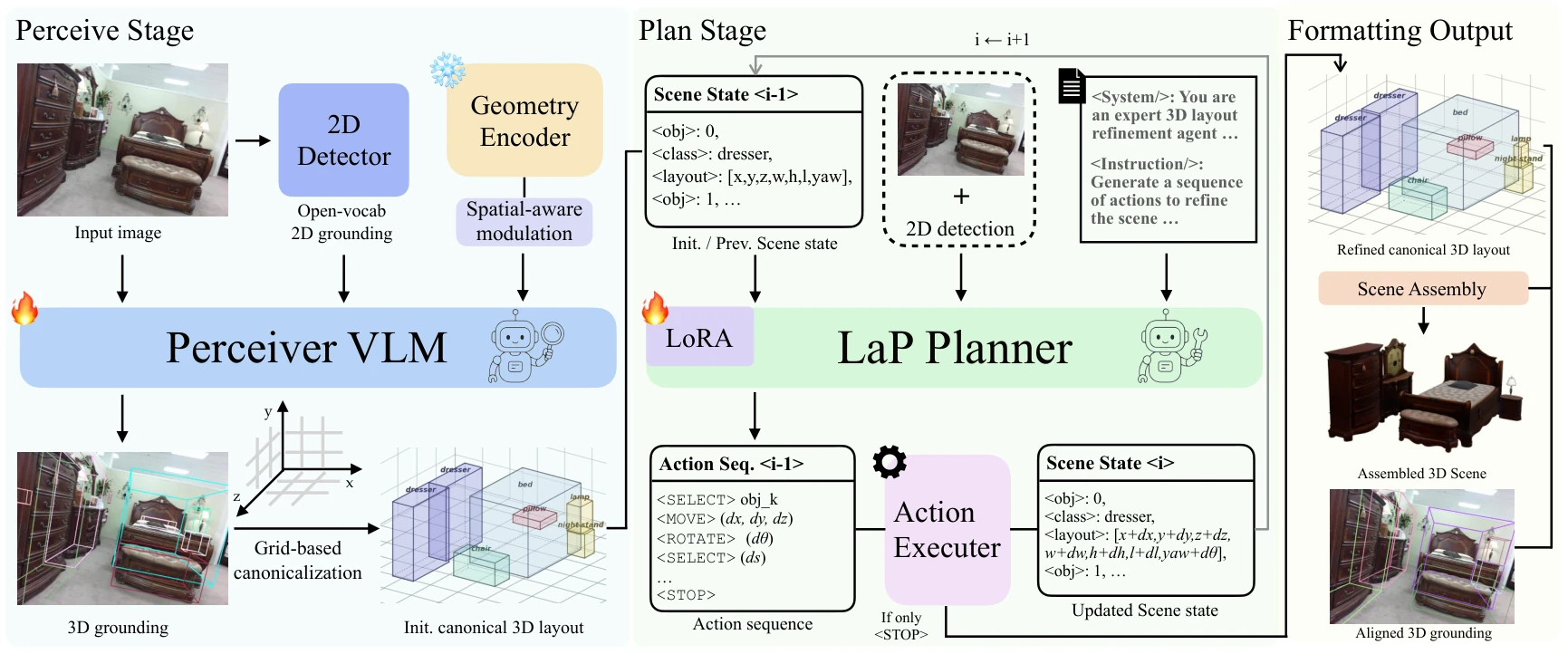
Building structured 3D scene layouts from a single image requires reconciling visual observations with physical and spatial constraints, a challenge that is difficult to address with direct prediction alone. In this work, we formulate monocular 3D layout estimation as a perceive-then-plan problem with vision-language models, where a Perceiver first grounds the 3D objects and then a Planner iteratively refines the scene hypothesis through actions that improve physical plausibility while preserving consistency with the input image.
We propose Layout-as-Policy (LaP), which casts the planning stage as a policy learning problem: 3D layouts are represented as structured states, and refined via discrete actions such as translation, rotation, and rescaling. Starting from an observation-aligned initialization with the geometry-enhanced Perceiver, the LaP Planner is trained to produce action sequences that progressively resolve geometric inconsistencies and enforce realistic spatial relations. To enable effective learning, we combine supervised sequence initialization with preference-based optimization, allowing the model to learn corrective behaviors without requiring explicit reward engineering.
This formulation transforms layout estimation from a one-shot prediction task into an iterative refinement process, enabling better handling of global constraints and complex object interactions. Experiments demonstrate that our approach produces layouts that are more physically coherent and better aligned with visual observations, while naturally supporting downstream tasks such as scene editing and manipulation.